Chickens and eggs
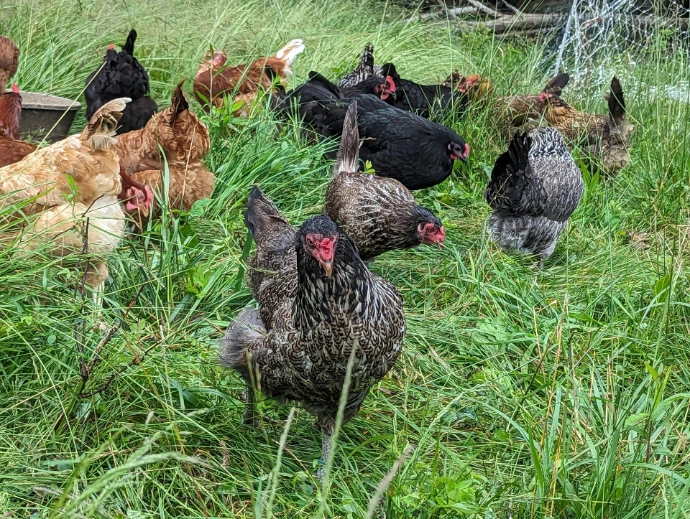
Here at BOTL Farm, we raise many fine animals, but if we have to choose our favorite species, it wouldn’t be chickens. A lot of farmers (and backyarders and homesteaders) start with chickens, but that’s not true for us. We started with rabbits, who are fuzzy, silent, and scrupulously clean animals. When we first decided to add a flock of chickens to our farm, we noticed they were not fuzzy, actually quite loud, and pooped everywhere. Hmm.
However, we continue to raise laying hens for many reasons. First, our eggs are delicious and we can’t imagine life without them. Second, their poop does wonders for our pastures since they helpfully spread it around for us. Finally, they do important work in our intensively managed rotational grazing system by helping to interrupt the cycle of parasite propagation by digging through the manure of other species and helping it break down faster.

Our flock of laying hens is Animal Welfare Approved by A Greener World and is fed a corn-free, soy-free, non-GMO, and certified organic feed. They live on pasture and are rotationally grazed. Their nesting boxes, roosts, and weather protection are in a sweet-looking 1990’s RV that we drag around with our tractor to take the chickens to new areas. They are free to go in and out of their mobile home as they please and they spend most of their time on pasture doing what we affectionately call ‘chicken stuff,’ which means walking in circles, scratching, and pecking at the ground looking for tasty bugs and things.
Living with boys
The laying hens live with a small number of roosters. Many roosters are territorial and will fight, but we’ve managed to balance the ratio of hens and roosters in such a way that the roosters mostly leave each other alone and focus on watching for predators.
On a good day, the roosters almost seem to work together, strategically spacing themselves out around the edges of the flock of hens as they forage, and moving around to make sure there’s an eye on everyone. The roosters have recognizably different alarm calls, so much so that our faithful farm dogs have learned the rooster call for ‘hawk’ and will search the sky when they hear it. Well, okay, just Pup looks at the sky, Ruff just bounces around Pup and wags.

Breed
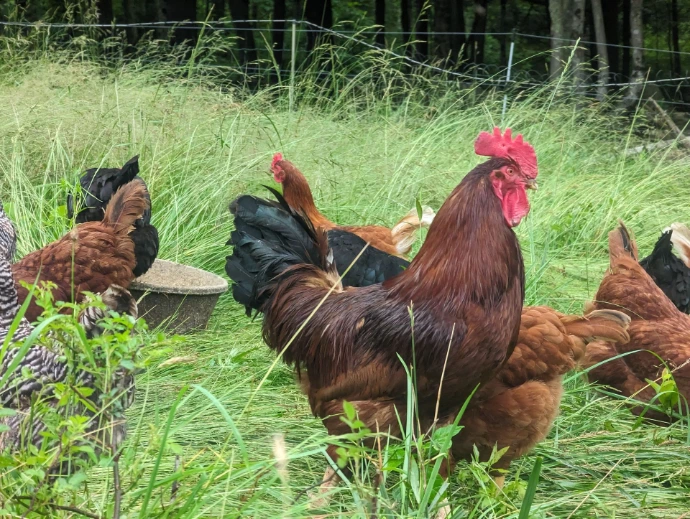
We have a staggered-age flock, so every year our breeds change slightly as we brood up new chicks to replace the oldest half of the existing flock. When we first got chickens, we looked like gardeners in January, pouring over their seed catalogs. We picked all sorts of heritage breeds and some Polish chickens, just for the laughs. Because we had a variety of breeds and they were on pasture year-round, we got a feel for which breeds did better than others. Black Australorps were too broody. Rhode Island roosters were great, despite the internet saying they're aggressive.
Despite how healthy the birds looked, our annual egg production per bird was always really low. Maybe even 'heritage' breeds now do better on corn and soy-based feeds? We really didn't know.

Brown egg layers
We started experimenting with sex-linked layer chicks. These are crosses of two different breeds (sometimes heritage breeds) that are bred more specifically for egg laying productivity. These are worlds away from industrial breeds, but they're not quite heritage breeds either. Initially we weren't sure they'd be hardy enough to do well on pasture or forage well or live outdoors all year round, but we've continually been surprised. As of 2026 we're using all sex-link brown egg layers and they're hardy, thrifty birds with more consistent productivity. Totally recommend.

Green egg layers
But, we do still want blue, olive, and green eggs to sell! So we also raise some heritage breeds birds still: green egg layers, Ameraucanas or Easter Eggers. Also, they’re the hawkiest-looking chickens around.
What the chickens eat
Chickens spend much of their time foraging, hunting, and pecking at the ground when they live on pasture. They forage for grasses, seeds, and other plant-based forages. However, chickens who have any say in the matter are absolutely, definitely, not vegetarians. We once saw a chicken who successfully hunted, caught, and somehow managed to swallow a one foot long, wriggling, live snake — in one gulp. It was amazing. The chickens regularly catch crawly bugs, flying insects, mice, spiders, and ticks. These non-vegetarian findings seem to be their favorite and they compete to get a piece of the prize.
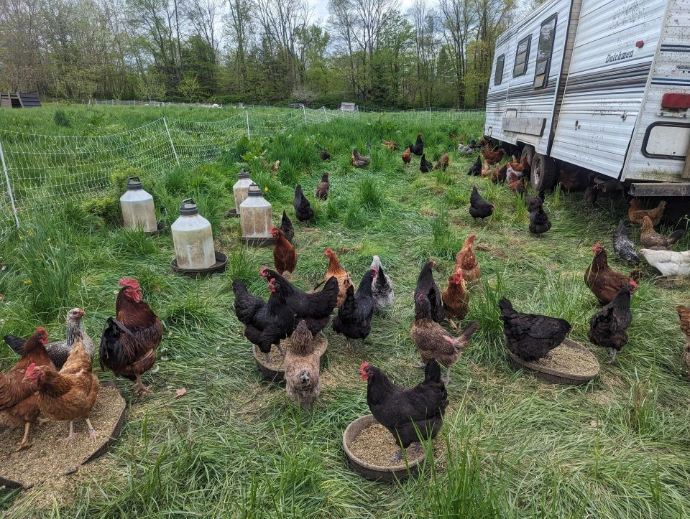
But chickens won’t thrive on grass and forage alone. We feed a grain-based ration that is custom designed and milled for our farm. It’s corn-free, soy-free, non-GMO, and certified organic. The main feed ingredients are barley, wheat, field peas, sunflower meal, sustainably sourced fishmeal, and alfalfa. These are balanced with Fertrell company poultry nutrient mix that includes vitamins, minerals, salts, and probiotics. Due to the way their digestive systems work, chickens need (and seemingly like) to ingest rocks (called ‘grit’ in the biz). We provide insoluble granite grit, as well as oyster shell (which is [slowly] soluble but also a great source of calcium) during laying.
What we make
Eggs
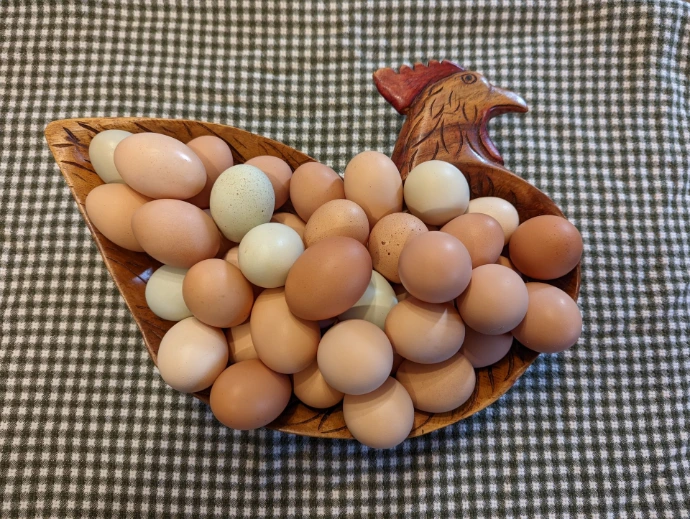
To reduce the amount of packaging in the world (and save money), we offer our eggs as “loosies” for customers who bring their own egg cartons or containers (buckets, pockets, bowls). We also offer eggs packaged in our cartons by the dozen. Eggs are available year-round, but the chickens lay less in the colder months than the warmer months.

Roasters
Although we don’t raise chickens strictly for meat, there are a few times that we cull chickens and end up with chicken meat available. First, when we buy day-old chicks to brood up for new laying hens, we buy sexed chicks, but sexing day-old chicks is notoriously difficult. We end up with a few roosters, so when they’re old enough to tell the difference, we cull juvenile roosters for meat.

Stew hens
We also sell older stew hens once they have lived out their egg producing life, which is typically around 2.5 years old as we retire our oldest layers and replace them with new layers. Stew hens are tougher and largely not suitable for frying or roasting, but are wildly flavorful, perfect for soups, stews, long-braised dishes, and pulled chicken.

Bone broth
We often debate the difference between stock, broth, and bone broth but haven’t found a satisfactory answer. What we know is that we take bones and heads from our animals, add water, and vigorously boil for hours. The resulting thing we normally call bone broth for simplicity, but it is worlds away from the stuff in a can in grocery stores.

Treats
When the fancy strikes us, we make pulled chicken and 'dragon' chicken (our absolutely flavortastical take on buffalo chicken dip).


Buying options
A la carte
Eggs are available by the dozen. Save a bit of money and bring your own cartons!
What we don't sell
Live Chickens
Want live chickens? We don’t sell them. In accordance with our farm’s welfare standards, we can only sell live animals to a farm with a current Animal Welfare Approved certification for the species they want to purchase.
Cuts
The little bit of chicken meat we sell is in whole bird form.
Nutritional benefits of pasture-raised eggs and chicken
These are fact sheets about hens/eggs and meat from FACT (Food Animal Concerns Trust) and highlight some of the nutritional benefits of pasture-raised eggs and chickens compared to conventionally-raised (aka in a barn, building, crate, or cage). We love a good FACT fact sheet!

Page Last Updated on 2026-01-09