Pigs
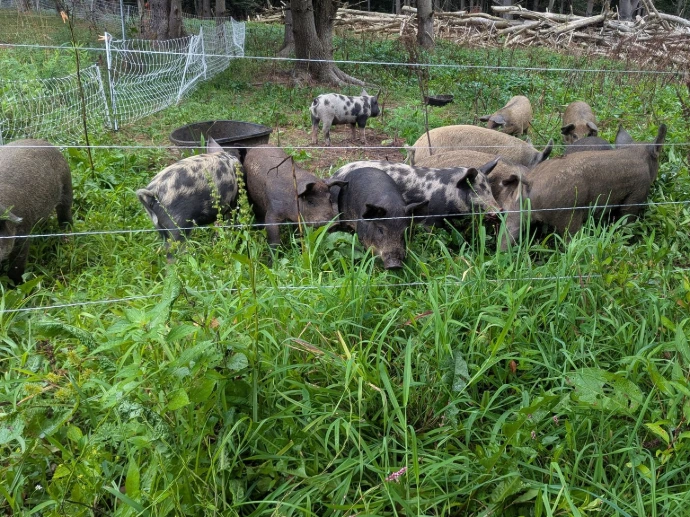
Here at BOTL Farm, we raise many fine animals, but if we have to say we focus on one species in particular, it’s pigs. Pigs are delightful animals who are delicious, intelligent, curious, and will sing us songs as we walk to new paddocks together.
We are a farrow-to-finish farm, which means that we breed sows who give birth on farm (and on pasture) to piglets. We raise the piglets from birth to slaughter.

They are Animal Welfare Approved by A Greener World, raised on pasture and in forest (eat the forest, pigs!) for their entire lives, all year round, so they’ve never seen the inside of a barn.
The pigs are fed a corn-free, soy-free, non-GMO, certified organic feed, on which they grow for 7-9 months to a finishing weight of 200-300 lbs.
Breeds
Like the rest of our livestock here at BOTL Farm, our pigs are heritage breed. We’ve put a lot of thought into what specific breed of pigs to raise. All of our pork comes from pigs with a mix of Mangalitsa, Large Black, and a lil’ something else. Why this mix?

Mangalitsa
Originally from Romania Hungary region, this breed, when pure-bred, is so hairy they look like a cross between a pig and a sheep. Having pigs that are part Mangalitsa makes them just-the-right-amount of furry for us, which adds to their hardiness and cold tolerance during winter. The side benefit is that they have been carefully bred for world-class quality, delicious-tasting fat as well! Mangalitsas are quite slow-growing, but to us the benefits are worth the time required.

Large Black
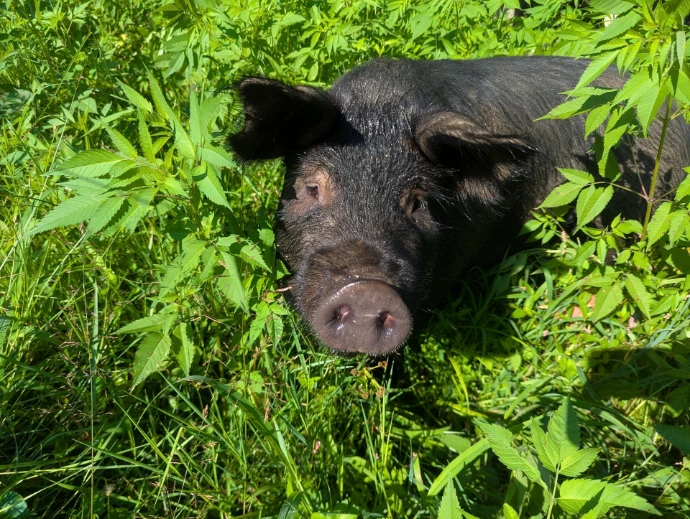
Large Black pigs are a breed that are, perhaps unsurprisingly, large and black. They have characteristically ‘lopped’ ears which look like giant eyeshades and grow very long, lithe torsos. They’re known for being friendly, even docile, as well as fantastic mothers on pasture. This probably stems from their high drive to find and consume forage, which keeps them happy when pasture-raised and sad when not. The sows and their piglets have excellent, calm dispositions that make them a delight to work with each day. This breed is also slow-growing, although not quite so much as Mangalitsa.

Berkshire / other
To balance the lard-y, slow-growing Mangalitsa and Large Black breeds in our pigs, we also use a leaner, slightly faster-growing breed. This is often Berkshire, but we occasionally use Red Wattle or Duroc as well. These breeds most likely originate from England and were bred to be well-muscled and have superior muscle quality. Berkshire pigs are also known as Kurobuta or the “wagyu” of pork (strictly speaking, we don’t agree with this designation since Berkshire is not known for its intramuscular fat marbling, but Mangalitsas are!).
What the pigs eat
A pig who can’t use their powerful nose to root around in the grass, or push rocks around, or work on landscaping projects, or dig for grubs, is not a happy pig. This is why we never keep pigs indoors or on dirt lots or confined in pens, since in these situations they can’t use their noses to manipulate their environment in this way that is so primal, so vital to them. During all this rooting and foraging, they discover and eat all sorts of things including grasses, legumes, sedges, roots, shrubs, small trees, nuts, flowers, grubs, worms, and well, really anything they can find. In the winter when the ground is frozen, they lose the ability to dig in the ground so we provide them hay to manipulate and eat.

But (most) pigs won’t thrive on grass and forage alone. We feed a grain-based ration that is custom designed and milled for our farm. It’s corn-free, soy-free, non-GMO, and certified organic. The main feed ingredients are field peas, wheat, barley, and alfalfa. These are balanced with Fertrell company swine nutrient mix that includes vitamins, minerals, salts, and probiotics. It also includes a little Icelandic kelp to boost trace minerals and omega acids, like the natural vitamin pill kelp is.
What we make

Cuts
Our cuts are typically bone-in with 0.25-0.5 inch fat cap (for things like pork chops and roasts). We have spareribs, babyback ribs, country-style ribs, tenderloin, kabob, ground, fresh belly, fresh jowl, etc.

Bacon
We have a deep commitment to making bacon, so we have regular (belly) bacon, Canadian bacon, pork roll/cottage bacon (also known as shoulder bacon), bacon ends, and jowl bacon.

Sausage
We have loose sausages, sausages in 0.25 lb patties, and linked sausage. We typically have chorizo, bratwurst, hot Italian, breakfast, and liverwurst. We hand-make several of these ourselves in a commercial kitchen, as well as our Sausage Adventure, which are one-time flavor experiments.

Odd stuff
As part of our commitment to sustainability , we save and sell “everything but the oink.” This includes heart, tongue, head, feet/trotters, skin, back fat, leaf fat, bones, kidney, liver, spleen, caul fat, trachea, and esophagus.

Bone broth
We often debate the difference between stock, broth, and bone broth but haven’t found a satisfactory answer. What we know is that we take bones and heads from our animals, add water, and vigorously boil for hours. The resulting thing we normally call bone broth for simplicity, but it is worlds away from the stuff in a can in grocery stores.

Charcuterie
Yes, we're committed to sustainability, but also to making the most delicious pork products you've ever had. We take prime cuts from our pigs to make soppressata, an old-world style slow-cured dry salami. It's shelf stable and the perfect local addition to charcuterie boards.

Lard
Lard may not have the best reputation right now, but history shows that people have raised heritage breed pigs and selected them for fat production and quality for centuries. Such that lard has a long history of being a primary cooking and baking source of fat. We also like to point out that for New England locavores, it’s the only versatile fat source available!
Further, we raise part Mangalitsa pigs specifically because the breed is world renowned for fat quality and taste. Being true to the history of raising pigs, we view the fat on our pigs as a great resource and opportunity to make nutritious, delicious, local fats. So, we go to our local cooperative commercial kitchen and do the long, boring step of rendering the fat into ready-to-use lard.
Lard is our go-to cooking fat in the kitchen. Cooking eggs, use lard. Sautéing veggies, use lard. Deep or shallow frying, use lard. When we need to lube a pan, dish, baking sheet, etc., use lard. Old-fashioned stove-made popcorn, use lard. Recipes that call for any oil, substitute lard. Need butter for a recipe? Try lard.
Bakers love lard! Pie crusts, biscuits, cookies… yum!
For a real treat just try some warm lard, a little salt, and some nice bread. You may never ask for butter on your toast again.
Don’t want to eat it? Try making soaps, candles, lip balm, lubricate your machining project, or just season cast iron dishes.

Lard soap
We’ve been making soap for ourselves for many years, even before we were farming. The primary ingredient is rendered lard from our pigs which undergoes saponification (yes this is the actual term) when mixed with just-the-right-amount of lye. Every time we make a batch of soap it’s a little different than the last, but we often have two main types on hand.
The first is white-ish in color and is made from lard but also a little something else (coconut oil) to add foaminess. These bars are a little moisturizing, or in soap terms, superfat (having more fat than the lye can saponify). They’re finished with essential oils to add a hint of aroma (like tea tree or lemon) to keep them (and you) smelling pretty and fresh. We mostly use this as a hand and body soap, but we’ve heard stories of others successfully using it as shampoo and grating it for laundry. It’s a simple, versatile soap.
The second is brown-ish in color and is made from lard and pine tar. It’s a little less foamy and has a heavier aroma of pine and forest (and maybe a hint of pig). We make it so that it’s slightly drying and use it when we have poison ivy (which is most of the time) to help dry out our skin a bit.
We sometimes experiment with other soapy projects, such as liquid soap, soap concentrates, and lard only soaps.


Buying options
A la carte
We sell everything by the individual package.
Bulk
Want an assortment of cuts but don’t want to pick them out one-by-one?
Want a larger amount of pork at once and have the room to store it?
Want to commit to a large amount of pork at once but don’t have the room to store it?
We have a solution for all these: consider a pre-made box, a large meat box, or a meat CSA. See this page for options and details!
What we don't sell
Whole and half pigs
Want a whole or half pig? Because of limitations imposed at the slaughterhouse we use, we can’t offer whole or half pigs for purchase. However, we can put together (mostly) any size FrankenPig “Box” for you from our current inventory. See our bulk buying page for options.
Roaster pigs
Want a roaster pig? Unfortunately, we do not offer roaster pigs.
Piglets
Want live piglets? Want breeding sows? We don’t sell them. In accordance with our farm’s welfare standards, we ONLY sell live animals to a farm with a current Animal Welfare Approved certification for the species they want to purchase.
Hams
We often get requests for hams, especially around holidays, but we have never been able to consistently sell hams so we stopped trying many years ago. When we tried, we ended up eating an amazing amount of ham ourselves. Ham is good, but we prefer other things so we no longer offer hams.
Nutritional benefits of pasture-raised pork
This is a fact sheet from FACT (Food Animal Concerns Trust) and highlights some of the nutritional benefits of pasture-raised pigs compared to factory farmed (aka in a barn or building or concrete slab or cage) pigs. We love a good FACT fact sheet!

Page Last Updated on 2026-03-08